
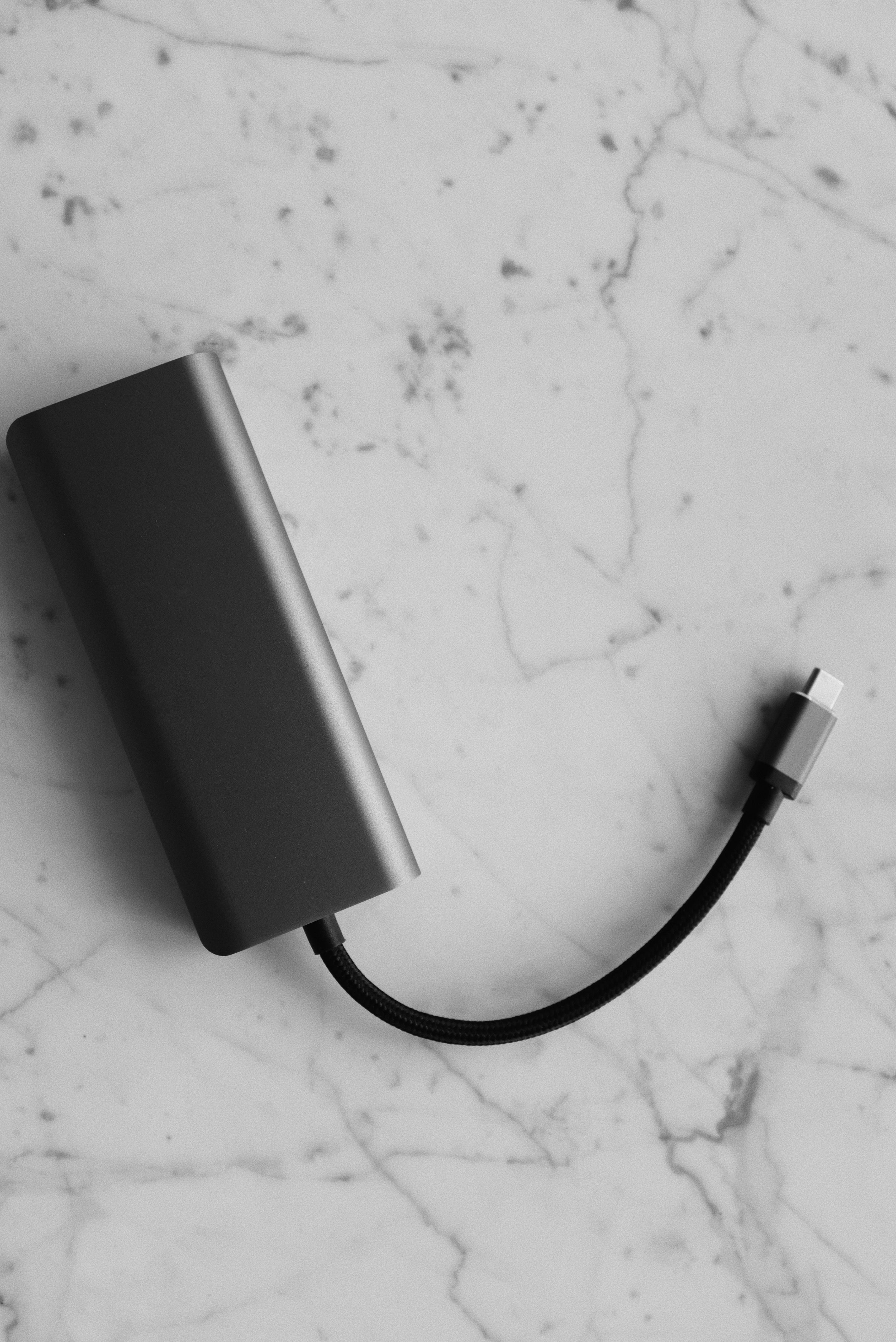
Photo: ready made / Pexels, used under the Pexels License; rotated clockwise 90 degrees, cropped and resized. Illustrative still life; capacity, certification and flight acceptance are not established by the image. Pexels photo source · Pexels License
Power banks can travel in the cabin, but must not go in checked baggage. On flights departing Hong Kong, each passenger may carry no more than two power banks, and recharging them during the flight is prohibited. Cathay Pacific and HK Express also prohibit using a power bank to charge your phone or storing it in an overhead compartment. When packing, check capacity, quantity and storage together.
Departing Hong Kong: How Many Can You Bring, and Where Should They Go?
The Hong Kong Civil Aviation Department’s current requirements apply to all flights departing Hong Kong International Airport: a maximum of two power banks per passenger, carried in the cabin only. Two is the total limit, rather than two large power banks plus a small one. Sharing a cabin bag with a travelling companion does not remove the individual limit.
Airlines may impose additional restrictions. Cathay Pacific and HK Express, for example, require the following:
- Keep power banks out of checked baggage.
- Do not recharge a power bank on board or use it to charge or power another electronic device.
- Do not leave it inside cabin baggage in an overhead compartment. Follow the airline’s instructions to store it in a personal bag under the seat in front or another designated location.
Before departure, check the Hong Kong Civil Aviation Department’s notice and the operating airline’s rules. Different airlines may operate each leg of a connecting itinerary, so check the actual operators rather than just the booking platform.
Check Capacity in Watt-hours, Not Just Milliamp-hours
Figures such as 10,000mAh and 20,000mAh describe capacity, while aviation rules commonly use watt-hours, or Wh. The calculation is:
Wh = mAh ÷ 1,000 × nominal cell voltage in volts
All examples below assume a nominal cell voltage of 3.7V:
| Labelled capacity | Calculation | Watt-hours |
|---|---|---|
| 10,000mAh | 10,000 ÷ 1,000 × 3.7 | 37Wh |
| 20,000mAh | 20,000 ÷ 1,000 × 3.7 | 74Wh |
| 30,000mAh | 30,000 ÷ 1,000 × 3.7 | 111Wh |
Start with the Wh rating and cell specifications printed on the product itself. A USB output of 5V or 9V is not the nominal cell voltage, and “100W fast charging” describes power rather than a capacity of 100Wh. Use the product’s actual cell voltage instead of assuming every model is 3.7V.
Build Travel Miles from Eligible Monthly Rent
Pay eligible rent through RentSmart with an applicable mileage-earning credit card, and you may earn travel miles under your card issuer’s reward terms.
Explore RentSmart Rent Payments and Miles
Cathay Pacific and HK Express: Can You Bring a 111Wh Power Bank?
The 30,000mAh, 3.7V example above is 111Wh, exceeding the power-bank capacity requirements published by both airlines:
- Cathay Pacific: Its safe-carrying guidance states that spare batteries, including power banks, must be under 100Wh. A 111Wh power bank does not meet this requirement.
- HK Express: Power banks and the relevant spare lithium-ion batteries must not exceed 100Wh, so a 111Wh model is also over its limit.
In the examples above, the 10,000mAh/37Wh and 20,000mAh/74Wh models meet these capacity requirements. They must still comply with the two-per-person limit, clear labelling, battery-condition and storage rules. Cathay lists separate 100–160Wh medium-battery examples for professional equipment and medical devices; use the power-bank-specific requirements when choosing an ordinary power bank.
Cathay power-bank guidance · HK Express battery rules
How Should You Pack and Protect a Power Bank?
- Check the label: Keep the Wh rating, or capacity and voltage information, clearly legible. Cathay explicitly refuses lithium batteries without a clear capacity rating.
- Protect each one separately: Use the original packaging or a protective case. Insulate exposed terminals where necessary to prevent short circuits from contact with keys, coins or other metal objects.
- Keep it accessible in a personal bag: Once on board, follow the airline’s storage instructions and disconnect cables linking it to other devices.
- Remove it if your cabin bag is checked at the gate: Take the power bank out and keep it in the cabin. Clearing security does not make it suitable for the aircraft’s hold.
Do not bring a swollen, damaged or abnormally hot power bank to the airport. Check whether the manufacturer has recalled the model or batch. If you notice a problem on board, tell the cabin crew immediately rather than putting it back in your bag or taking it apart.
Do You Need a 3C Mark When Travelling to Mainland China?
Mainland domestic flights have a separate requirement. From 28 June 2025, power banks without a 3C mark, with an unclear mark, or belonging to a recalled model or batch are prohibited. If your itinerary includes a mainland domestic flight, prepare for that segment’s requirements too. See the Civil Aviation Administration of China’s notice.
This is separate from Hong Kong’s departure quantity limit and airline capacity rules; it is not a blanket 3C requirement for every flight leaving Hong Kong. A 3C mark also does not override capacity, condition or quantity limits.
Prepare for Your Next Trip Through Everyday Rent Payments
Alongside packing your bags, you can gradually build miles for your next trip through everyday spending. Consider paying rent through RentSmart with an applicable mileage-earning credit card: eligible rent payments may earn travel miles under your card issuer’s reward terms.


